hi ↑ stuart clark:
one solution should be 
I believe that as one way to proceed you could find antiderivative to the left side of the equation
and then rewrite the equation as 
what you only need then is first and second derivative of  on positive half of the real line
(as will be even function) getting 2 more positive real solutions, ultimately getting total of 5 real solutions
in more detail if needed
Skrytý text:we study equation

for

,

by the behaviour of the funcion
we have

,
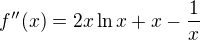
rewriting

as

shows that
if and only if

as function

is increasing on the definition range
directly giving

and

those observations tells us together with

that
the function

has a global minimum in
with

,
and that

"grows" to

continuously if moving to the left and also if moving to the right of
therefore there are exactly two points

in definition range of
such that

furthermore there is

and hence

,

giving that
has in

local maximum and in

local minimum
now we have

and

for

so

for
reaching maximum at

then,

and

for

so from the positive maximum
decreases to still positive value at
so no solutions for
there
we can now notice that for

there is already

as

and

thus the point
lies somewhere in the interval

picking

from the interval like

(I picked closer to 1 because the value

is obviously closer to 0 then

we get
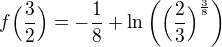
that is obviously negative
so we learned that
go negative on some subinterval of
together with what we learned about
,
and
this tells us that it's here where
crosses the line

for exactly two times and nowhere else it does
as
is even function we get also 2 more negative solutions for

which gives us total of 5

 for all