#1 28. 07. 2014 09:21
- stuart clark

- Příspěvky: 1015
- Reputace: 7
Reduction Integral
If  and
and 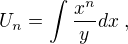 Then prove that
and deduce that  and
and 
Offline
#2 13. 08. 2014 11:17 — Editoval Bati (13. 08. 2014 16:29)

Re: Reduction Integral
↑ stuart clark:
There're probably mistakes in , I think it should be  (*).
(*).
To see this, consider the expression  and compute it two-way. Firstly, write
  - this is true for every integer
  . Secondly, use integration by parts to obtain
  - that is true for non-zero integers . By comparing the right-hand sides of last two equations, multiplying and collecting terms together we get the equation (*). But this isn't enough to simply deduce particular case since what we just proved doesn't hold for
  . This obstacle, however, can be circumvented with little magic:
 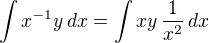 and we use integration by parts again (differentiate
  ) to get
  and this clearly proves the first particular case. The second one is a simple consequence of the first one and (*) in case of
  .
.
Offline