 Where
Where #2 17. 01. 2015 11:02

Re: maximum value
↑ stuart clark:![$\mathrm{Dom}_f=\mathbb{R}\setminus\{\sqrt[3]{-1\pm\sqrt 2}\}$](/mathtex/11/11c05f91d87a9ed9b250ee47134ade00.gif "kopírovat do textarea") . Both numbers where the function f is not defined are less than 1, so f is a continous function for
. Both numbers where the function f is not defined are less than 1, so f is a continous function for  . Let us find the derivative of f:
Let us denote  . Then the complex numbers
  and
and  are roots of
  , therefore
  divides and
The equation  is an algebraic reciprocal equation. Let us divide it by
  and modify it in the following way:
The equation has only two real roots:  and
and 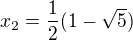 . Therefore
  is divisible by
  and
and
moreover  has no real roots and
  for .
for .
Using the previous results we can express the derivative f' in the following way:
If then there is only one stationary point, 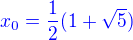 . Since
  is positive on
  and negative on
  , the point
  is a global maximum of
  on
on  . Finally,
Backslash je v TeXu tak důležitý jako nekonečno při dělení nulou v tělesech charakteristiky 0.
Offline
#3 22. 01. 2015 09:28
- stuart clark

- Příspěvky: 1015
- Reputace: 7
Re: maximum value
↑ Pavel: Thanku pavel for Nice explanation.
My Solution ::
Given  Where
Where
So We can Simplify 
Now Let 
So ![$\displaystyle f(u) = \frac{u}{u^3+3u+2}=\frac{u}{u^3+u+u+u+1+1}\leq \frac{u}{6\sqrt[6]{u^3\cdot u \cdot \cdot u \cdot u\cdot 1\cdot 1}} = \frac{1}{6}$](/mathtex/ab/ab3a14154bf283b8124fc25e092d89e1.gif "kopírovat do textarea")
Using  and above equality hold when
Offline
#4 22. 01. 2015 09:57
Re: maximum value
↑ stuart clark:
Nice solution. I suspected that mean inequalities were an appropriate tool to solve the problem. However, I did not find the right modification of the fraction.
Backslash je v TeXu tak důležitý jako nekonečno při dělení nulou v tělesech charakteristiky 0.
Offline