Stránky: 1
- Hlavní strana
- » Zajímavé úlohy z matematické analýzy
- » inverse function (TOTO TÉMA JE VYŘEŠENÉ)
#1 27. 05. 2011 09:33
- stuart clark

- Příspěvky: 1015
- Reputace: 7
inverse function
If  . then
Offline
- (téma jako vyřešené označil(a) byk7)
#2 09. 06. 2011 16:41 — Editoval Marian (09. 06. 2011 16:49)

 denotes the real number for which

 and
and  as
as  . Hence there exists exactly one real number
  .
.
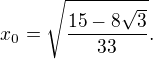
 is a sufficiently large positive integer s.t. both terms on the left hand side are positive. Now, computing the tangent of the left and right hand side gives




#3 10. 06. 2011 11:24 — Editoval Pavel (10. 06. 2011 11:26)

Re: inverse function
↑ Marian:
I solved the problem by means of complex analysis:

 in the set of polynomial with complex coefficients, we get that
  where
where  is the complex unit. Then we can express the integral above as a sum of logarithmic functions with complex variable, thus


 is a solution of the problem.
Backslash je v TeXu tak důležitý jako nekonečno při dělení nulou v tělesech charakteristiky 0.
Offline
Stránky: 1
- Hlavní strana
- » Zajímavé úlohy z matematické analýzy
- » inverse function (TOTO TÉMA JE VYŘEŠENÉ)