

#2 10. 11. 2011 12:05 — Editoval vanok (10. 11. 2011 14:01)
Re: infinite sum
Hi ↑ stuart clark:,
First of all your expression has a sense because terms can be considered as limits of two sequences increasing and limited by 4.
Let us note M.
The second term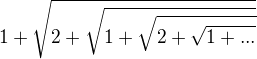
is the limit K of the sequences
So K verify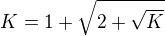
I confidedthe calculation of  to wolframalpha
Which gives the value approached( and exact form also)
look here
http://www.wolframalpha.com/input/?i=K- … t+K%29%3D0
On the other hand the first term L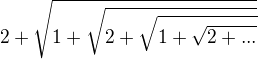
Give 
So 
the approached value of which is: look to wolframalpha
http://www.wolframalpha.com/input/?i=2- … sqrt2.9263
Sincerely
Srdecne Vanok
The respect, the politeness are essential qualities...and also the willingness.
Do not judge the other one.
Ak odpovedam na nejaku otazku. MOJ PRINCIP NIE JE DAT ODPOVED ALE UKAZAT AKO SA K ODPOVEDI DOSTAT
Offline
#3 10. 11. 2011 13:25 — Editoval Honzc (10. 11. 2011 13:27)
Re: infinite sum
↑ vanok:
Zdravím, já teda nevím, ale výraz dá větší součet než  už pro první dva "členy". Tedy
Navíc se rozhodně nerovná 
 a
a 
Offline
#4 10. 11. 2011 13:45 — Editoval vanok (10. 11. 2011 14:09)
Re: infinite sum
Hi ↑ Honzc:,
Thank you.
Look directly at the result on wolpframalpha (An error of typing that I corrected)
Otherwise, that you think of this fast solution drafted in 5 minutes.
Srdecne Vanok
The respect, the politeness are essential qualities...and also the willingness.
Do not judge the other one.
Ak odpovedam na nejaku otazku. MOJ PRINCIP NIE JE DAT ODPOVED ALE UKAZAT AKO SA K ODPOVEDI DOSTAT
Offline
#6 10. 11. 2011 14:11
Re: infinite sum
↑ Honzc:
Read my messages previous ones
Srdecne Vanok
The respect, the politeness are essential qualities...and also the willingness.
Do not judge the other one.
Ak odpovedam na nejaku otazku. MOJ PRINCIP NIE JE DAT ODPOVED ALE UKAZAT AKO SA K ODPOVEDI DOSTAT
Offline
#8 11. 11. 2011 14:31 — Editoval Pavel (11. 11. 2011 16:40)

Re: infinite sum
↑ stuart clark:
Using the theory of symetric polynomials I found a polynomial such that one of its root is the given expression. Thus, the expression fulfils the equation
However, the roots cannot be expressed in a nice form, see.
Backslash je v TeXu tak důležitý jako nekonečno při dělení nulou v tělesech charakteristiky 0.
Offline
#9 11. 11. 2011 21:34
- check_drummer

- Příspěvky: 5577
- Reputace: 106
Re: infinite sum
Pavel napsal(a):
↑ stuart clark:
Using the theory of symetric polynomials I found a polynomial such that one of its root is the given expression.
Hi, can you please write the solution using symetric polynomials - or at least the idea of your reasoning? Thank you.
"Máte úhel beta." "No to nemám."
Offline
#10 13. 11. 2011 14:35 — Editoval Pavel (13. 11. 2011 14:39)
Re: infinite sum
↑ check_drummer:
Hi, let us denote
The convergence of nested radicals was discussed here. So we can assume that  is defined correctly and it is a finite real number.
Let us define
It is easy to see that  and
and  . It means that
  is a root of the algebraic equation
Suppose that  are all the roots of the equation. Then using Vieta's formulas, we obtain that
Now we will derive a polynomial  from the given one such that all its roots are the numbers
  and therefore also is a root. It is not necessary solve the equation
  , it suffices to find the coefficents
  using
using  , Vieta's formulas and symmetric polynomial identities that can be proved by elementary techniques. We will use some of them as:
If is supposed to have roots then the following identities have to be true (due to Vieta's formulas):
We have found the polynomial  such that
where
Backslash je v TeXu tak důležitý jako nekonečno při dělení nulou v tělesech charakteristiky 0.
Offline
#11 13. 11. 2011 16:25
- check_drummer
- Příspěvky: 5577
- Reputace: 106
Re: infinite sum
Thank you for your solution, Pavel. Nevertheless:
Pavel napsal(a):
However, the roots cannot be expressed in a nice form
Why not? Roots of the polynomial of degree 4 can be expessed in nice (=closed) form.
"Máte úhel beta." "No to nemám."
Offline
#12 13. 11. 2011 16:56
Re: infinite sum
↑ check_drummer:
Yes, you are right. Despite of expressing in a closed form, it is necessary to use a lot of radicals. If we knew
another way of solving the problem, it might be expressed in a more simple form. However, I doubt about it.
Backslash je v TeXu tak důležitý jako nekonečno při dělení nulou v tělesech charakteristiky 0.
Offline
