
#2 22. 11. 2011 17:21 — Editoval vanok (22. 11. 2011 18:26)
Re: floor function sum
Hi
Let S the sum to find.
This exercise it resolves very simply thanks to the following inequalities : ![$1\le \sqrt[k]{\frac k {k-1}}=\sqrt[k]{1+\frac1{k-1}}\le 1+\frac1{k.(k-1)}=1-\frac1k+\frac1{k-1}$](/mathtex/78/78fffef9004a02197d613f79051872f8.gif "kopírovat do textarea")
All the terms eliminate two-two except both extrêmes.
By using them for  and by adding we obtain:
And finally 
Srdecne Vanok
The respect, the politeness are essential qualities...and also the willingness.
Do not judge the other one.
Ak odpovedam na nejaku otazku. MOJ PRINCIP NIE JE DAT ODPOVED ALE UKAZAT AKO SA K ODPOVEDI DOSTAT
Offline
#3 22. 11. 2011 17:35 — Editoval stuart clark (22. 11. 2011 17:40)
- stuart clark

- Příspěvky: 1015
- Reputace: 7
Re: floor function sum
↑ vanok:
thanks vanok
but how can i prove ![$1\le \sqrt[k]{\frac k {k-1}}=\sqrt[]{1+\frac1{k-1}}\le 1+\frac1{k.(k-1)}$](/mathtex/0f/0fea69a18d69f07533d3287f28b9ce3d.gif "kopírovat do textarea")
Offline
#4 22. 11. 2011 17:49 — Editoval vanok (22. 11. 2011 18:55)
Re: floor function sum
↑ stuart clark:,
For example by means of the Bernoulli's inequality:
The inequality states that
for every integer k≥ 0 and every real number x ≥ −1.
For 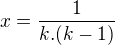 we obtain our result.
Srdecne Vanok
The respect, the politeness are essential qualities...and also the willingness.
Do not judge the other one.
Ak odpovedam na nejaku otazku. MOJ PRINCIP NIE JE DAT ODPOVED ALE UKAZAT AKO SA K ODPOVEDI DOSTAT
Offline