Stránky: 1
- Hlavní strana
- » Zajímavé úlohy z matematické analýzy
- » quadratic equation (TOTO TÉMA JE VYŘEŠENÉ)
#1 25. 01. 2012 20:08
- stuart clark

- Příspěvky: 1015
- Reputace: 7
quadratic equation
Let  and
and  are the roots of the equation
and  and
and  are the roots of the equation
  . Then find
(i) 
(ii) value of 
Where  are Distinct Real numbers
Offline
- (téma jako vyřešené označil(a) byk7)
#2 29. 01. 2012 14:32 — Editoval Sulfan (31. 01. 2012 19:23)

Re: quadratic equation
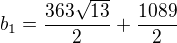
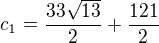
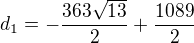
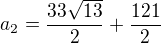
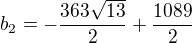
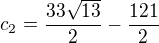
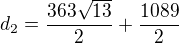
 ) with 4 real different solutions. However, only 2 quaternions (a,b,c,d) are distinct real numbers, so that the only 2 solutions are: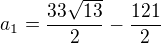
Offline
#3 31. 01. 2012 15:44
Re: quadratic equation
Hi ↑ Sulfan:,
I have the other solutions
For example:
 . In that case
  and two equations become
I shall develop my solution when I shall more have time
Srdecne Vanok
The respect, the politeness are essential qualities...and also the willingness.
Do not judge the other one.
Ak odpovedam na nejaku otazku. MOJ PRINCIP NIE JE DAT ODPOVED ALE UKAZAT AKO SA K ODPOVEDI DOSTAT
Offline
#4 31. 01. 2012 16:30
- Pavel Brožek

- Místo: Praha
- Příspěvky: 5694
- Škola: Informatika na MFF UK
- Pozice: Student
- Reputace: 194
Re: quadratic equation
↑ vanok:
Hi, four zeros are not distinct real numbers :-). I think that Sulfan has found all solutions.
Offline
#5 31. 01. 2012 17:46
Re: quadratic equation
↑ Pavel Brožek:
Hi, you're right, in fact there are 4 possible solutions as I mentioned.
Except Vanok's also  , but I understood under the term distinct numbers, that there shouldn't be any same pair of numbers.
Offline
#6 31. 01. 2012 18:16 — Editoval Pavel Brožek (31. 01. 2012 18:21)
- Pavel Brožek
- Místo: Praha
- Příspěvky: 5694
- Škola: Informatika na MFF UK
- Pozice: Student
- Reputace: 194
Re: quadratic equation
↑ Sulfan:
I think that the solutions with not distinct real numbers are and  .
.
Edit: You didn't use Vieta's formulas correctly – the absolute term in quadratic equation is product of the roots without a minus sign.
Offline
#7 31. 01. 2012 19:22
#8 02. 02. 2012 05:09
- stuart clark
- Příspěvky: 1015
- Reputace: 7
Re: quadratic equation
Thanks to all,
but anyone explain me how can i get 
Thanks
Offline
#9 02. 02. 2012 14:22
Re: quadratic equation
↑ stuart clark: By solving the system of equation as an immediate result of Vieta's formula.


Offline
#10 03. 02. 2012 12:33
Re: quadratic equation
Hi,
Finally, I have again the INTERNET connection
According to me, it is not enough to give answers without justification, but it is necessary to justify them.
Indeed, the solution that I quoted has ↑ Sulfan: do not answer at the request of ↑ stuart clark:, however to be able to answer his question, it seems to me to analyze, the problem in the possible more general case and then, to indicate solutions which he wishes to see.
On the other hand, I notice that the solution of ↑ Sulfan:, was revised with Viète's correct relations
However his solutions do not verify are not still right.
Then, I give here my analysis of this problem.
I am anxious to specify, that all the results are not obtained by equivalences so it is indispensable to verify that the solutions obtained verify the equations initially composed.(cf.↑ stuart clark:)
After this introduction, here is my attempt of solution of this problem (to criticize if need be)
Viète's relations of 2 equations are:
Where from we obtain: product
  and
and
where still
What gives us following three cases or
or  or
or 
1° If Viète's relations become
Finally
2° The symmetric case also looks
A remark, the cases  and
and  give too
Remark:The solution give and two equation are
Let us suppose henceforth that 
3°
give 


Finally (provided that  is effectively a root not zero of the initial equation)
………………………….. give
give

and 

The first equation ↑ stuart clark: given has for root , so , what give thanks to

Also, the second equation ↑ stuart clark:given has for root , so what give thanks to

- give,
Where from
So we have to examine 2 cases
1° 
et
2°

Study of case 1° , give with that 
For  Viète's relations become
What drives to a contradiction.
For  Viète's relations become
What gives: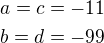
And in that case there both equations of departure become
and
Study of case 2°
with
show that has  are solutions of the equation
Thus
Viète's relations :
allow to express  corresponding
But we obtain a contradiction with 
CONCLUSION:
The problem admits only two solutions in \mathbb{R^4},
1)
with and two equation are
and
2)
and in that case there both equations of departure become
with
and anybody which satisfied by the announced requirements.
Srdecne Vanok
The respect, the politeness are essential qualities...and also the willingness.
Do not judge the other one.
Ak odpovedam na nejaku otazku. MOJ PRINCIP NIE JE DAT ODPOVED ALE UKAZAT AKO SA K ODPOVEDI DOSTAT
Offline
Stránky: 1
- Hlavní strana
- » Zajímavé úlohy z matematické analýzy
- » quadratic equation (TOTO TÉMA JE VYŘEŠENÉ)