#1 02. 02. 2012 04:55
- stuart clark

- Příspěvky: 1015
- Reputace: 7
common normal
The maximum no. of Common Normals of  and
and  is equal to
options::
(i) 
(ii) 
(iii) 
(iv) 
Offline
#2 05. 02. 2012 18:43 — Editoval vanok (06. 02. 2012 08:23)
Re: common normal
Hi ↑ stuart clark:,
The equation, 
give

So in the point  ,
, of the parabola we have
Thus a equation of the shape 
is a tangent of our parabola,if
and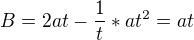
Finally  is an equation of the tangent of the parabola at the point ,... for all t
The slope of the normal at the point ,, is  .
.
So an equation of the shape

is a normal of our parabola, if
and
Finally ,
,
is an equation of the normal of the parabola for all t.
We notice that the equation is "symmetric" with ,  .
.
What gives us mechanically an equation of the normal of the parabola is
and finally an equation of the normal of the parabola for all t,
of the shape 
is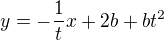 ,
, .
.
For  the equation ,, we have
 is a normal of parabola for all m.
And  the equation ,, we have
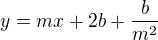 , is a normal of parabola for all m.
Thus common normals verify:
what gives , an equation in m of the fifth degree
Conclusion: Option (iii):
The maximum no. of Common Normals of and is equal to 5.
Srdecne Vanok
The respect, the politeness are essential qualities...and also the willingness.
Do not judge the other one.
Ak odpovedam na nejaku otazku. MOJ PRINCIP NIE JE DAT ODPOVED ALE UKAZAT AKO SA K ODPOVEDI DOSTAT
Offline
#3 07. 02. 2012 06:22 — Editoval jardofpr (07. 02. 2012 07:19)
Re: common normal
↑ vanok:
suppose

![$\Rightarrow \bigg( [P(m)<0 \,\, \forall m \in (-\infty, m_{1})\cup(m_{2},m_{3})\cup(m_{4},m_{5})]\wedge$](/mathtex/e7/e7ad3defbccb3e656345090cce10566c.gif "kopírovat do textarea")
![$\wedge[P(m)>0 \,\, \forall m \in (m_{1}, m_{2})\cup(m_{3},m_{4})\cup(m_{5},\infty)]\bigg) \stackrel{P\in C(\mathbb{R})}{\Rightarrow}$](/mathtex/ef/ef516ae20c8d0d0ee37cf6eb3c2f15ff.gif "kopírovat do textarea")
![$\stackrel{P\in C(\mathbb{R})}{\Rightarrow} \bigg(\exists c_{1},c_{2},c_{3},c_{4}\in\mathbb{R}\bigg):\bigg(\bigg[c_{i} \in (m_{i},m_{i+1})\bigg]\wedge\,\bigg[P'(c_{i})=0\,;i=1,2,3,4\bigg]\wedge $](/mathtex/bb/bb4a32af106adb8367b34440d49b1a29.gif "kopírovat do textarea")
![$\wedge \bigg[P'(m)>0 \,\,\forall m \in (-\infty,c_{1})\cup(c_{2},c_{3})\cup (c_{4},\infty)\bigg]\wedge \bigg[P'(m)<0\,\,\forall m \in (c_{1},c_{2})\cup(c_{3},c_{4})\bigg]\bigg)\Rightarrow$](/mathtex/32/3255723e27be338a2e15d71ad1af4754.gif "kopírovat do textarea")

(the same line for  ,
,  will turn to
  and to on the corresponding intervals of monotonicity of
  , but the result is the same )
back to your final equation

nonzero roots
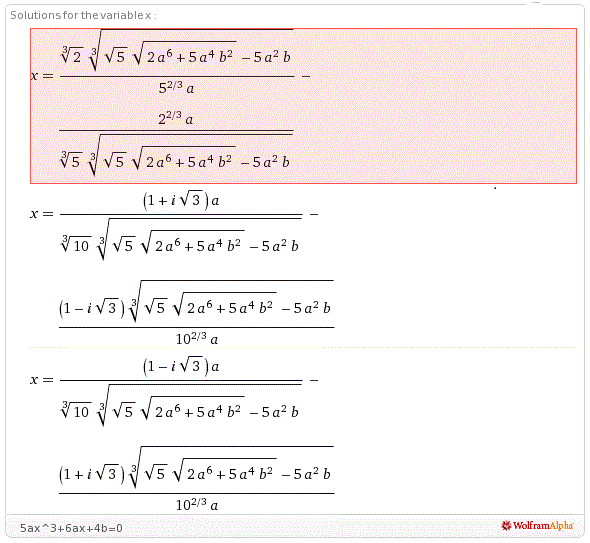
for
 is easy to show that the number of common normals of the given equations is less then 5
all the options



imply that number of common normals of given equations is less than 5
is that correct?
Offline
#4 07. 02. 2012 10:27 — Editoval vanok (07. 02. 2012 12:28)
Re: common normal
Hi ↑ jardofpr:,
The obtained answer is valid in  .
.
I left this question aside:
Which is the maximal number of real solutions of the equation obtained, for a, b suitable.
I have shall look at your approach, in this frame, in detail, to know if can have 1, 3 or 5 real solutions.
EDIT:Remark: I have think, that one can pose: ,(the cases a=0; b=0 are to be excluded) what gives:
 ,
,
And in first approach, the study of function (in several cases particular) seems to me to confirm, that the equation finds admits only 1 real solution.
Srdecne Vanok
The respect, the politeness are essential qualities...and also the willingness.
Do not judge the other one.
Ak odpovedam na nejaku otazku. MOJ PRINCIP NIE JE DAT ODPOVED ALE UKAZAT AKO SA K ODPOVEDI DOSTAT
Offline
#5 07. 02. 2012 14:49
Re: common normal
↑ vanok:
thanks, I was confused a bit,
because I couldn't even find more than one common normal for any ordered pair [a,b] :)
then i was wondering, if I should consider a,b,x,y alltogether as the variables, but still the problem was to find the fifth normal ..
i was not thinking about complex solutions, cause (I don't know why but) I supposed the task is to find the real solutions ...
Offline
#6 12. 02. 2012 17:33
- stuart clark
- Příspěvky: 1015
- Reputace: 7
Re: common normal
Thanks vanok for nice explanation
and thanks jardofpr
Offline