Stránky: 1
- Hlavní strana
- » Zajímavé úlohy z matematické analýzy
- » positive divisers of 10 factorials
#1 25. 02. 2013 10:01
- stuart clark

- Příspěvky: 1015
- Reputace: 7
positive divisers of 10 factorials
(1) Total number of positive diviser of  which are is in the form of
  where
where 
(2) Total number of positive diviser of which are is in the form of  where
where
(3) Total number of positive diviser of  which are is in the form of
  where
where
(4) Total number of positive diviser of which are is in the form of  where
where
Plz explain me in detail.
Thanks
Offline
#2 25. 02. 2013 15:46
Re: positive divisers of 10 factorials
(1) so its divisors are of the form
  , where
  . We need
  so
so  and
and  . Since
  we have that
  .
.
Now we want the number of solutions of this equation within the aforementioned ranges. Suppose that  so we have exactly two solutions for
  for every choice of parameters
  what yields
  solutions. Next we need solutions for
  i.e.
i.e.  . Similarly suppose
 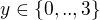 and we have one solution for every
  i.e.
i.e.  solutions. And finally we need solutions for
  so
so  and there is exactly one. Altogether we have
  solutions i.e.
  divisors with the desired form. You can verify it on W|A.
(2)-(4) should be simmilar.
Offline
#3 25. 02. 2013 17:44
- stuart clark
- Příspěvky: 1015
- Reputace: 7
Re: positive divisers of 10 factorials
Thanks Brano
But would You like to explain me that part
and . Since we have that .
Offline
 iff
iff  so
so  .
. so
so  .
. then
then  or in other words if
  then
then  .
. for
for  to obtain
 iff
iff 
#5 25. 02. 2013 18:29 — Editoval stuart clark (25. 02. 2013 18:42)
- stuart clark
- Příspěvky: 1015
- Reputace: 7
Re: positive divisers of 10 factorials
Thanks ↑ Brano: Got it.
plz apolozise me for again asking for explanation of that part
Suppose that so we have exactly two solutions for for every choice of parameters what yields solutions. Next we need solutions for i.e. . Similarly suppose and we have one solution for every i.e. solutions. And finally we need solutions for so and there is exactly one
Offline
#6 04. 03. 2013 20:12
Re: positive divisers of 10 factorials
Sorry, I havent noticed that you've editted your last post into question.
So,
the point is that we are about to count number of solutions of  . Suppose that are fixed numbers and
  . You have exactly one solution
  . Now if
  we have two solutions
  and
and  . So we only count the number of pairs and multiply it by 2. Doing this we have omitted solutions where so we substitute this into the equation and proceed analogically.
Offline
#7 13. 03. 2013 15:32
- stuart clark
- Příspěvky: 1015
- Reputace: 7
Re: positive divisers of 10 factorials
Thanks ↑ Brano: Got it
Offline
Stránky: 1
- Hlavní strana
- » Zajímavé úlohy z matematické analýzy
- » positive divisers of 10 factorials