Stránky: 1
- Hlavní strana
- » Zajímavé úlohy z matematické analýzy
- » Integral of ceiling-floor function


#2 03. 09. 2013 13:56
Re: Integral of ceiling-floor function
Here is my trial of the first one.
1) Reducing the first integral into sum:
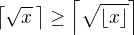 , but when
 ? That is if and only if there is
  such that
 i.e.
i.e. 
 on intervals
  and is
  otherwise. Thus
2) Non-rigorous computaion of the sum:
 . It can be expressed as an infinite power series, with infinite radius of convergence, and thus it can be analyticaly continuated in whole
  . The zeros of
  are
are  for
for  and
and  . Here comes the non-rigorous part - we will treat it as a polynomial and factorize it into ireducible terms over



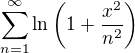
3) I don't have the rigorous method but here are some thoughts:

Offline
#3 03. 09. 2013 18:45

Re: Integral of ceiling-floor function
Offline
Stránky: 1
- Hlavní strana
- » Zajímavé úlohy z matematické analýzy
- » Integral of ceiling-floor function