↑ Marian:
Hi, here is my solution:
Skrytý text:Let
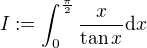
; this improper integral is clearly convergent (both limits are finite at bounds).
First part: It is not hard to show, that

.
Since

, one can use substitution

in the given integral, yielding the integral
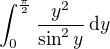
. Now it's enough to apply integration by parts.
Second part: Evaluate

using conjugate Fourier series of a suitable function.
Let

for

,

and extend this definition to

so that

is

-periodic. Obviously,
is odd therefore Fourier coefficients

are all zero. For

we have
.
So, by the definition, the conjugate Fourier series of
is of the form:
, specially .
Now we use the fineteness of
to compute the conjugate function of
at

(it would be much harder anywhere else anyway):
.
The equality
=\widetilde{f}(0)$](/mathtex/17/1771cfff1b1805bd81e99259822d3e25.gif "kopírovat do textarea")
then follows from the analogue of Dini's criterion for classical Fourier series (it' s enough to check, that
is integrable over period and that
is finite, what we did), so we get the result

.
P.S. I'm currently writing my thesis on conjugate Fourier series so this was easy for me, though I know the solution might look quite extraordinary. I'm very interested in other methods you have to evaluate this for comparison. I will gladly provide more details on the criterion I used or on conjugate series, conjugate function in general if you like.


=\sum_{k=1}^{\infty}(a_k\sin{kx}-b_k\cos{kx})$](/mathtex/22/220b606a26cef260b4e69939d1fb102f.gif "kopírovat do textarea") , where
, where  are Fourier coef. of f, which can be derived in a similar way as for the classical Fourier series (conjugate Dirichlet kernel is sum of sines):
 - the first integral is then the conjugate function (the limit in def. now being unnecessary) and second integral tends (uniformly) to 0 by Riemann-Lebesgue lemma. This is exactly the Dini criterion I used. It is primitive but telling - one can see that the convergence of conj. series depends on local behaviour of f, whereas the sum depends on all values of f.