

#2 17. 07. 2014 17:52
Re: Limit of a trigonometric sequence
Limit: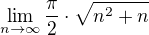

násobky pi/2 jsou:
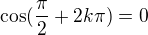

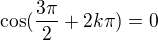
Jelikož je tam na 4 tak se ze záporných hodnot stanou kladné. Limita neexistuje, bude se pohybovat v intervalu 
L'Hospitalovo pravidlo neexistuje. Byl to výsledek Johanna Bernoulliho
Offline
#4 17. 07. 2014 20:59
Re: Limit of a trigonometric sequence
Seriously?
If i take some high number, for example:
so 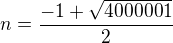
: 
I take some another high number, for example:
so n = 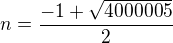

and this is different result... So there cant be exact value.
L'Hospitalovo pravidlo neexistuje. Byl to výsledek Johanna Bernoulliho
Offline
#5 17. 07. 2014 21:48
Re: Limit of a trigonometric sequence
It probably should've been mentioned that it's supposed to be a limit of a sequence, so  , not
, not  , even though
  is almost never used for reals.
Therefore, the argument of the cosine approaches  and the cosine alternates between
  and
and  , which gives the result:
  .
.
Offline
#6 18. 07. 2014 15:04
Re: Limit of a trigonometric sequence
Offline
#7 22. 07. 2014 23:05
- check_drummer

- Příspěvky: 5577
- Reputace: 106
Re: Limit of a trigonometric sequence
↑ Xellos:
Hi, can you please explain the connection of your limit and the limit that should be computed? Thank you.
"Máte úhel beta." "No to nemám."
Offline
#8 23. 07. 2014 00:37 — Editoval Brano (23. 07. 2014 00:38)
Re: Limit of a trigonometric sequence
↑ check_drummer:
maybe this will be more comprehensible (based on ↑ Xellos:)![$2\cos^2\left(\frac{\pi}{2}\sqrt{n^2+n}\right)-1=\cos(\pi\sqrt{n^2+n})=\cos(\pi[\sqrt{n^2+n}-n]+\pi n)=$](/mathtex/40/40b78d62d4c2502c418ceb6c6c87151d.gif "kopírovat do textarea")

therefore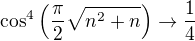
Offline
#9 23. 07. 2014 02:41 — Editoval Xellos (23. 07. 2014 02:41)
Re: Limit of a trigonometric sequence
↑ Marian:
Oh, the title. [insert facepalm here]
↑ check_drummer:
Well, since the argument of  approaches for large , and is a continuous function, then
 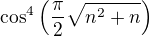 will approach
 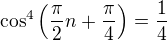 . It's kinda rough, but you should get the picture (yes, you should go and draw a graph of the situation :D).
Offline