
![$(a){\max\limits_{x,y\in [0,1]}(x^2y-xy^2)}$](/mathtex/9d/9d448355c03d2d439549ae2fa05e162e.gif "kopírovat do textarea") and
and ![$(b){\max\limits_{x,y,z\in [0,1]}(x^2y+y^2z+z^2x-xy^2-yz^2-zx^2)}$](/mathtex/85/854ca44afe91013187696a465400be62.gif "kopírovat do textarea")
#2 15. 01. 2015 09:44

Re: maximum of f(x,y)
↑ stuart clark:
(a) Let us define a quadratic function  of a single variable which depends on a fixed real parameter
  . Then
and it is easy to see, that  and
and  are two roots of
  . Thus has a global maximum point
  , so the maximal value of is
Since ![$x\in[0,1]$](/mathtex/a3/a35805693e94e4f44290ccd56f46ee4a.gif "kopírovat do textarea") , we have
, we have![$
{\color{blue}\max\limits_{x,y\in [0,1]}(x^2y-xy^2)=\max\limits_{x\in [0,1]}Q(y^*)=\frac 14.}
$](/mathtex/1b/1b6c85435cf5cf1f08d0e017a8a56d90.gif "kopírovat do textarea")
The equality is satisfied for  and
and 
---
(b) We use the same technique.
Let us define  as a quadratic function of a single variable depending on two fixed real parameters
  . It has two roots
  and
and  , so it has a global maximum point
  . Maximal value of
  is
is
Since ![$y,z\in[0,1]$](/mathtex/fd/fd2c1755326b6647705c313677da0f18.gif "kopírovat do textarea") ,
,  is maximal, if
  and
and  . Thus
  and
and![$
{\color{blue}\max\limits_{x,y,z\in [0,1]}(x^2y+y^2z+z^2x-xy^2-yz^2-zx^2)=\frac 14.}
$](/mathtex/77/77ab5a0c0d594bdf24a0ac787b44054a.gif "kopírovat do textarea")
If we denote  then obviously
The given identity is satisfied also for 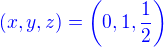 and
and 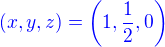 .
.
Backslash je v TeXu tak důležitý jako nekonečno při dělení nulou v tělesech charakteristiky 0.
Offline
#3 15. 01. 2015 10:15
Re: maximum of f(x,y)
↑ stuart clark:Elemenary solution of a:
1.  is symmetric w.r.t. the line , hence it is sufficient to work on the lower triangle.
2. is nondecreasing along the lines  on this triangle, hence the maximum will be of the type
 ![$[1,y]$](/mathtex/5a/5aaab4b2384f213ba223a2a25379382e.gif "kopírovat do textarea") .
.
3. The rest is trivial.
Offline