#1 05. 03. 2015 05:46
- stuart clark

- Příspěvky: 1015
- Reputace: 7
no. of real solution
If  Then no. of real solution of
  and
and  and
and 
Where  and
and  is floor function of
Offline

 so
so 
 , then
  so I think I don't understand the question as well.
 , then
  is
is 
#4 09. 03. 2015 22:53
Re: no. of real solution
↑ Freedy:
Since we have  and thus
  .
.
So we get  where the upper index means no. of iterations.
And every equation  has the only root
  .
.
This seems too easy, and that's why I am asking about corectness of the problem.
Příspěvky psané červenou barvou jsou moderátorské, šedá je offtopic.
Offline
#5 10. 03. 2015 04:09
- stuart clark
- Příspěvky: 1015
- Reputace: 7
Re: no. of real solution
Sorry ↑ byk7: . Now i have edited my question.
If 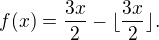 Then no. of real solution of and and
Where and is floor function of
Offline
#6 10. 03. 2015 07:28 — Editoval Freedy (14. 03. 2015 13:15)
Re: no. of real solution
Hi,
for  we have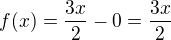

 .
.
All of these functions (and others) have only one real solution x = 0.
for  we have:
 one solution x = 2/3 but it's not in the interval
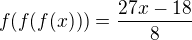 ...
...
We can find for  real solution
  and this solution is from the interval
  , therefore there are 2 real solutions for any
Freedy
L'Hospitalovo pravidlo neexistuje. Byl to výsledek Johanna Bernoulliho
Offline
#7 11. 03. 2015 15:38 — Editoval Kdosi (11. 03. 2015 15:39)
Re: no. of real solution
Hi, after your respons ↑ Freedy: I'm not sure of my solution, so if U'll find mistake, let me know.
First:  is function
  after
after  itteration.
If 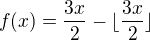 and .
and .  . It's easy to show there are 4 solutions for
  .
.
I think there is  solutions for
  . I'll prove it by induction.
For n=1 it's correct.
Then, for  :
:  . So number of solutions is eaqual to
  .
.
I know, I should show there is x in R, such, that 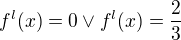 for all
  . But I realized it just when I was writting this and I dont have proved it yet.
Now it's really easy to find answer on↑ stuart clark:'s question.
My apologies, if I'm wrong.
Offline