↑ stuart clark:
sure I could, I just need to add that using the steps described there's whole lot of space for numerical mistakes,
so don't take the constants in the calculations below for granted, I tried myself first 3 steps before posting
step 1:
Skrytý text:integrand is defined for all

as the values of it are strictly positive.
you want to get

in the numerator first
numerator can be expressed as

so I substituted

,

giving

, where

getting (after expanding denominator)
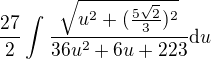
step 2:
Skrytý text:in last integral from (step 1) I substituted

,
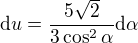
,

getting

giving

as

given the range for

step 3:
Skrytý text:into last integral from (step 2) I substituted

for

giving

,

,

, the expressions are put directly into integral above
after rearrangement and calculation of complex roots for polynomial of 4th degree I got to something like this
![$\frac{45}{223\sqrt{2}}\int\frac{1+2v^2+v^4}{(1-v)(1+v)[v^2+\frac{10}{223}(15-\sqrt{2})v+\frac{227-30\sqrt{2}}{223}][v^2-\frac{10}{223}(15+\sqrt{2})v-\frac{227+30\sqrt{2}}{223}]}\,\mathrm{d}v$](/mathtex/6a/6af27118d30b49e6a62200db3aba871a.gif "kopírovat do textarea")
step 4:
Skrytý text:
the last integral from (step 3) is ready for calculation using partial fractions method
this is where the real annoying work starts since the coefficients of the polynomials in denominator are
already horrible
and to get to partial fractions you need to solve the system of 6 linear equations with 6 variables with coefficients derived from those (this is where I expected the nasty work in my original post)
I did not proceed with this part but it is proven to be computable

 so that you get the integral like
 to get
 using
using 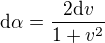 to get integral containing polynomials
