Matematické Fórum
Nevíte-li si rady s jakýmkoliv matematickým problémem, toto místo je pro vás jako dělané.
Nástěnka
❗22. 8. 2021 (L) Přecházíme zpět na doménu forum.matweb.cz!
❗04.11.2016 (Jel.) Čtete, prosím, před vložení dotazu, děkuji!
❗23.10.2013 (Jel.) Zkuste před zadáním dotazu použít některý z online-nástrojů, konzultovat použití můžete v sekci CAS.
Nejste přihlášen(a). Přihlásit
#1 05. 01. 2019 10:07
- stuart clark

- Příspěvky: 1015
- Reputace: 7
number of plane
If  are
are  distinct points in a space such that no three are collinear and points are not colpanar
Then the number of plane that are in the space and each of which is equidistant from is
Offline
#2 05. 01. 2019 15:10 — Editoval jardofpr (05. 01. 2019 15:42)
 and
and 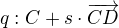
 giving the equation
 is not known
 for which the line
  lies in the plane
 such that line q lies in the plane
 are parallel since they share normal vector, let be
 ,
, 

 gives us equations for planes
  parallel to
 to
to  and the right side decreases from
  the point in first half-space and
  points in the second half-space
 and for sure there is unique plane
  going through
  between those two where
#3 05. 01. 2019 17:08 — Editoval check_drummer (05. 01. 2019 17:16)
- check_drummer

- Příspěvky: 5575
- Reputace: 106
Re: number of plane
"Máte úhel beta." "No to nemám."
Offline
#4 08. 01. 2019 14:27
- stuart clark
- Příspěvky: 1015
- Reputace: 7
Re: number of plane
tHANKS ↑ jardofpr:↑ check_drummer:
Offline