#1 16. 07. 2011 05:04 — Editoval stuart clark (16. 07. 2011 05:05)
- stuart clark

- Příspěvky: 1015
- Reputace: 7
min. of Complex
Let  then find Minimum value of
  also find corrosponding complex number
  .
.
Where 
Offline
#2 16. 07. 2011 18:21 — Editoval anes (16. 07. 2011 18:22)
Re: min. of Complex
 , you can consider
  instead. If you write it out as a function of real and imaginary part of z, you will se, the problem can be reduced to finding minimum of
  . Clearly, the minimum will be somewhere between 1/2 and 3/4. And since Q is continuous and having derivative of any order it's sufficient to investigate its local extremes (it's just a parabola, actually).
  and so the minimum of Q is obtained for
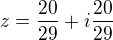 and I can't be bothered to calculate it.
Offline